
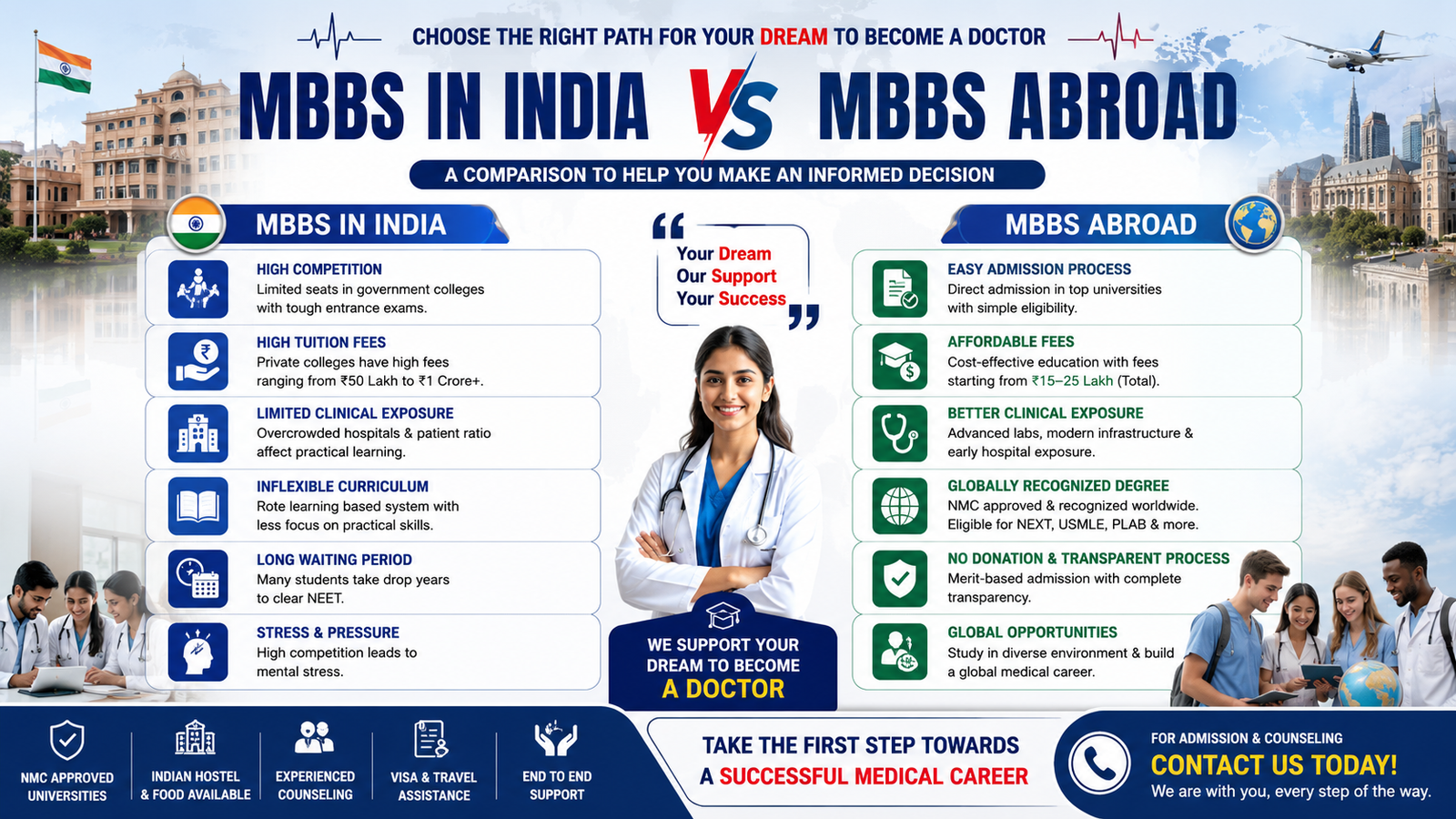
MBBS in India vs MBBS Abroad: Which Option is Better for Indian Students in 2026?
Introduction
Pursuing an MBBS degree is one of the most significant decisions in a student’s academic journey. Every year, lakhs of Indian students appear for the NEET examination with the dream of becoming a doctor. However, limited government medical seats and the high tuition fees of many private medical colleges have encouraged students to explore international medical education.
If you’re wondering whether you should choose MBBS in India or MBBS Abroad, this comprehensive comparison will help you understand the advantages, challenges, costs, eligibility, and career opportunities associated with both options.
Why Students Choose MBBS Abroad?
Many students prefer studying MBBS abroad because it offers quality medical education at a comparatively affordable cost. Universities in countries such as Georgia, Kazakhstan, Uzbekistan, Kyrgyzstan, and Russia provide English-medium programs, modern infrastructure, and an international learning environment.
For students who cannot afford the high tuition fees at many private medical colleges in India, studying MBBS abroad can be a cost-effective alternative.
Why Students Choose MBBS in India?
Private medical colleges in India are a suitable choice for students who wish to study within the country and remain familiar with the Indian healthcare system. Students also benefit from staying closer to family and following a curriculum aligned with Indian medical practice.
However, tuition fees in many private colleges are considerably higher than those at many overseas universities.
Subjects |
India |
Abroad |
Admission & Competition |
Admission is fiercely competitive. Over 2 million students compete for around 1 to 1.2 lakh seats. To secure a highly subsidised government seat, you need an exceptionally high NEET score and rank. | The process is much more straightforward. Most reputable foreign universities (in countries like Russia, Georgia, Kazakhstan, or the Philippines) do not require cut-throat competitive ranks or separate entrance exams. As long as you fulfil the eligibility criteria (minimum 50% in 12th PCB) and qualify for the NEET cutoff, you can easily secure admission. |
Cost of Education |
Government Colleges: Highly affordable, costing between ₹50,000 and ₹5 Lakhs for the entire 5.5-year course. Private Colleges / Deemed Universities: Extremely expensive. Total packages can range from ₹60 Lakhs to over ₹1.5 Crore, making them unaffordable for many middle-class families. |
Popular budget-friendly destinations (Russia, Georgia, Central Asia) offer the entire 6-year course (including food and accommodation) for ₹15 Lakhs to ₹45 Lakhs. This is significantly cheaper than private medical colleges in India. Note: Opting for Western countries like the US, UK, or Australia will be much more expensive, often exceeding ₹1–2 Crore. |
Clinical Exposure & Practical Training |
This is India’s biggest strength. Because of the high population density, Indian government hospitals experience an immense patient inflow. Students gain unmatched hands-on clinical exposure, dealing with a wide variety of medical cases daily. | Reputed international universities offer world-class infrastructure, advanced laboratories, and high-tech simulation centres. However, actual bedside patient interaction can be limited in some countries due to smaller population sizes or strict local hospital laws. |
Licensing Rules & Career Trajectory |
A standard MBBS is 5.5 years (including a 1-year mandatory internship). Previously, Indian graduates did not need a licensing exam to practice locally. | Foreign programs generally last 6 years (including an internship at the host institution). To practice in India, foreign medical graduates must comply with strict National Medical Commission (NMC) rules (e.g., minimum course duration of 54 months, English medium) and clear the licensing exam. |
The Equalizer
The NEXT (National Exit Test) is set to become mandatory for both Indian and foreign medical graduates to obtain a license to practice in India and secure post-graduation (PG) seats.
Final Verdict
Which should you choose?
Choose MBBS in India if you scored an excellent NEET rank to bag a government medical seat, or if your family can comfortably afford private medical tuition without severe financial strain and you prefer to stay close to home.
Choose MBBS Abroad if: You cleared and qualified NEET but missed out on an Indian government seat, and want a high-quality medical education without paying the skyrocketing donation or tuition fees of private Indian medical colleges. (Always ensure the foreign university you choose is completely NMC-compliant and listed in the World Directory of Medical Schools.