
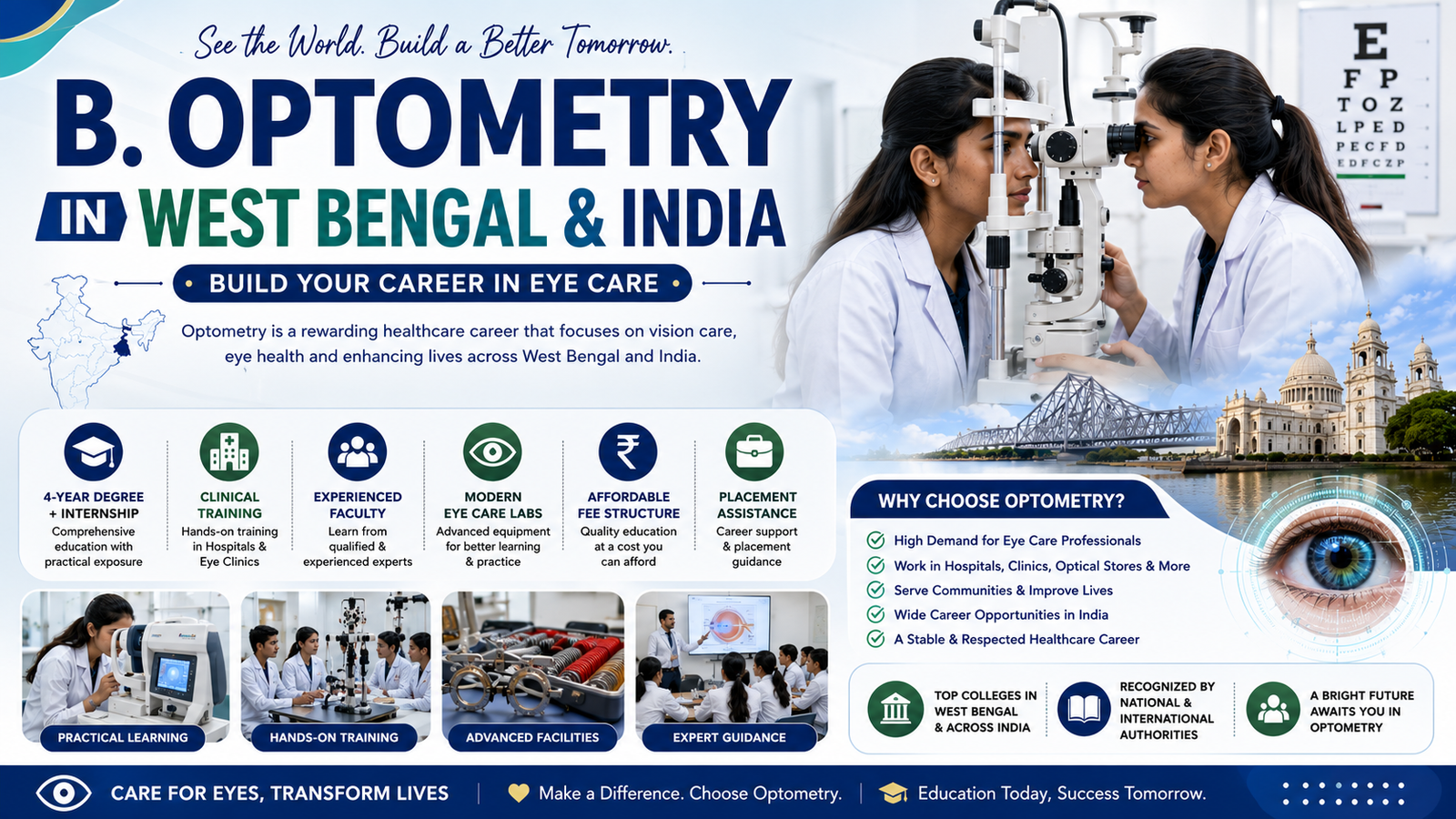
Why Pursue Optometry in West Bengal & India? Scope, Admission & Top Institutions
With screen times soaring across all age groups and awareness around preventive eye healthcare on the rise, Optometry has emerged as one of the most rewarding allied healthcare professions in India. Pursuing a Bachelor of Optometry (B.Optom or B.Sc. Optometry) equips students with the specialized skills needed to diagnose vision issues, prescribe corrective lenses, manage binocular vision, and assist in ophthalmic care.
If you are considering private universities in West Bengal and across India for an optometry degree, here is a breakdown of why this path is growing in popularity, what the program entails, and how to pick the right institution.
1. What is Optometry?
Optometry is an autonomous healthcare profession focused on primary eye care. Unlike an ophthalmologist (who is a medical doctor/surgeon), an optometrist specializes in:
- Conducting visual acuity tests and diagnosing refractive errors (nearsightedness, farsightedness, astigmatism).
- Fitting contact lenses and optical appliances.
- Detecting early signs of eye diseases (glaucoma, cataracts, macular degeneration) and referring patients to ophthalmologists.
- Providing vision therapy and pediatric/geriatric eye care.
Course Duration: Typically 4 years (3 years of academic coursework + 1 year of mandatory clinical internship).
2. Why Choose Optometry in West Bengal?
West Bengal—especially the Greater Kolkata region—has developed into a major hub for healthcare and paramedical education in Eastern India. Private universities in the state offer distinct advantages:
- State-of-the-Art Clinical Labs: Premier private universities invest in modern diagnostic equipment (optical coherence tomography, slit lamps, auto-refractometers) to give students practical exposure from day one.
- Tie-ups with Eye Hospitals: Many leading private institutions partner with premier eye care hospitals and centres across Kolkata and West Bengal for internship rotations.
- Affordability: Compared to tier-1 metropolitan hubs like Mumbai or Bengaluru, private universities in West Bengal offer competitive fee structures alongside scholarship opportunities.
3. Eligibility criteria
- Academic Requirement: Completion of 10+2 (Higher Secondary) in the Science stream with Physics, Chemistry, and Biology (PCB) or Mathematics (PCM) as core subjects.
- Minimum Marks: Usually 50% aggregate in 10+2 (varies by university).
- Admission Route: Direct merit-based admission on 10+2 marks or university-specific entrance tests/counseling sessions.
4. Career Opportunities & Salary Expectations
Optometry offers diverse career avenues upon graduation:
Career Path | Primary Role |
Clinical Optometrist | Working in private eye hospitals or clinics alongside ophthalmologists. |
Retail Optical Practice | Managing or consulting at leading optical chains (Lenskart, Titan Eyeplus, Lawrence & Mayo). |
Contact Lens / Lens Specialist | Working with lens manufacturers (Essilor, Johnson & Johnson, Bausch & Lomb). |
Entrepreneurship | Establishing your own independent optical practice or vision clinic. |
Higher Education & Research | Pursuing M.Optom or PhD to move into teaching or clinical research. |
Salary Range: Fresh graduates can expect an initial package ranging between ₹3.5 LPA to ₹6 LPA, which steadily increases with clinical experience, specialization, or personal practice.
5. Final Thoughts
A degree in Optometry from a well-equipped private university offers a direct line into the rapidly expanding healthcare sector. For students looking for high employability, hands-on clinical exposure, and a career with high social value, choosing an accredited program in West Bengal or across India is an excellent step forward.